
Utah People Directory Landscape
Utah does not maintain one current white-pages index for everyone in the state. Instead, official Utah people directories are organized by role and record keeper. Utah state workers appear in one narrow phone search. Utah regulated professionals appear in a license database. Utah business filings connect principals or registered agents to entities. The 29 Utah county recorders and assessors maintain local name indexes, while the Utah Historical Society and Utah State Archives preserve older residents in printed volumes, government series, and digital collections.
| Utah directory | People represented | Keeper | How to use it |
|---|---|---|---|
| Utah State Employee Directory | Current Utah state workers | State of Utah | Free exact first-and-last-name search |
| Utah agency staff lists | Officials and staff by unit | Individual Utah state agencies | Free browse or static page |
| Utah DOPL License Lookup | Licensed professionals and entities | Utah Division of Professional Licensing | Free name, profession, or license-number search |
| Utah business and principal search | Principals, agents, and debtors | Utah Division of Corporations | Online role-based search |
| Utah land and tax indexes | Owners, grantors, and grantees | Utah county recorder and assessor | County portal, counter, phone, or request |
| Utah City Directories | Past Utah residents, firms, and groups | Utah Historical Society | Digitized volumes and library holdings |
| Utah Archives name indexes | Parties in indexed government series | Utah State Archives | Catalog, digital index, or archivist help |
Start with the Utah directory tied to the person's known role. A full name and Utah state-agency link fit the employee tool. A trade or credential fits Utah DOPL. A known company fits the Utah principal search. An address usually requires the Utah county assessor, followed by the recorder. For a past resident, choose a Utah city-directory edition based on the place and year. School, chamber, congregation, alumni, union, neighborhood, and community-member directories are not centralized statewide; local access may be limited to members or a library collection.
Search Utah Government Directories
The Utah State Employee Directory is intentionally precise. It requires both a last name and a first name. There is no open browse by agency, and its notice bars use for mailing lists, marketing, or other commercial aims. This works well when the complete name and state connection are already known. It is less useful for initials, uncertain spellings, county staff, or city workers because those local employees are not part of the state phone book.
- Last Name: a required text field for the Utah worker's surname.
- First Name: a required text field for the Utah worker's given name.
- Search: the button runs the query only after both name fields are filled.
The official Utah employee-search screen shows how limited that entry point is.
View the source for the Utah state employee directory image.
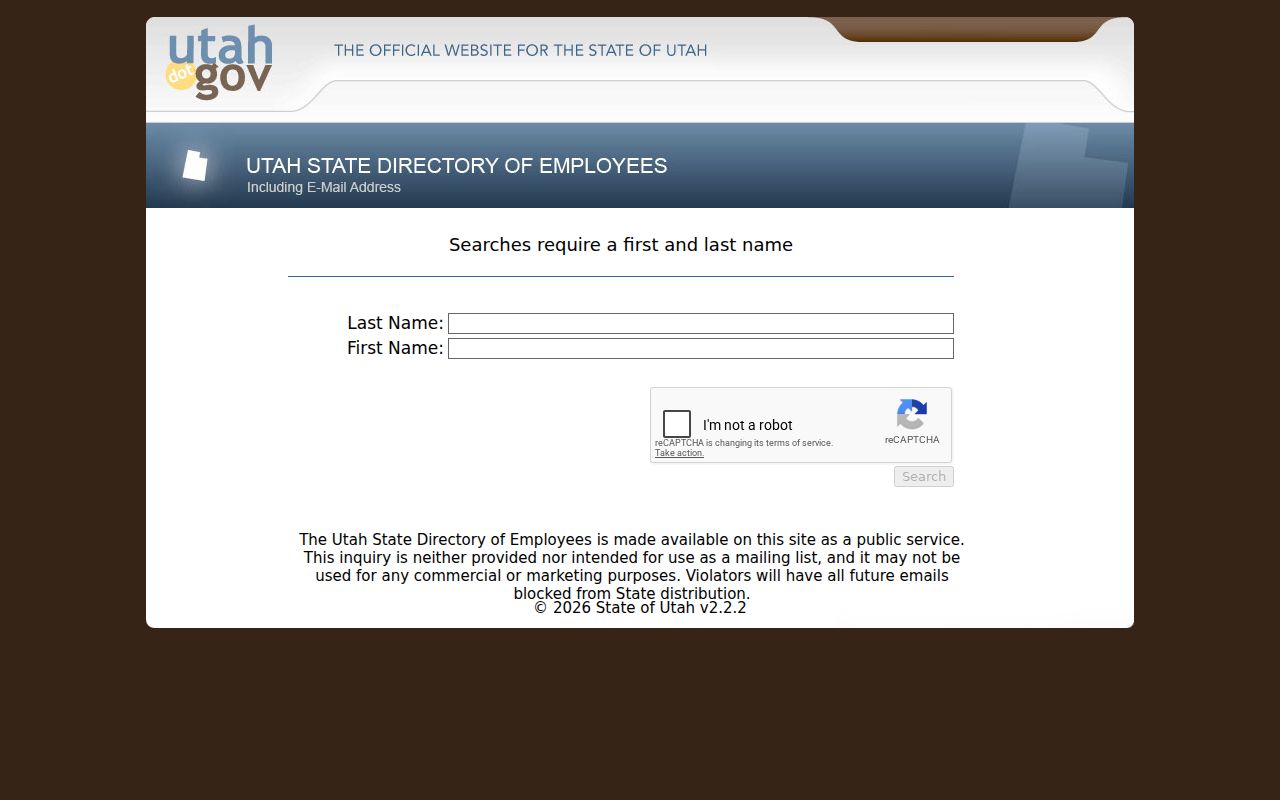
Its two required boxes make exact spelling far more important than it is in a broad Utah public index.
Agency staff pages provide the useful fallback. The Utah State Archives staff directory, for example, is a static list arranged by organizational section. It supplies a name, position, work phone, and email. Similar lists may expose direct contacts that the statewide form cannot reveal through browsing. For a city or county worker, use that government's official department pages or main line; Utah has no unified municipal employee directory.
Utah Directory Entry Details
A staff directory entry describes an official role, not a private-person profile. The Archives listing demonstrates the difference. It places a worker in an agency section and pairs the name with role and contact data. That context helps distinguish two people with the same name and identifies the right office for a public question. A sample entry includes Ken Williams, Director and State Archivist, with a direct work phone and state email address.
- Organizational section: the Utah division or team containing the entry.
- Name: the listed staff member.
- Position: the person's official function.
- Work phone: a direct or office contact number.
- Email: an official Utah agency address.
The Utah agency presentation makes those fields easy to compare.
Open the Utah State Archives directory shown in the captured image.
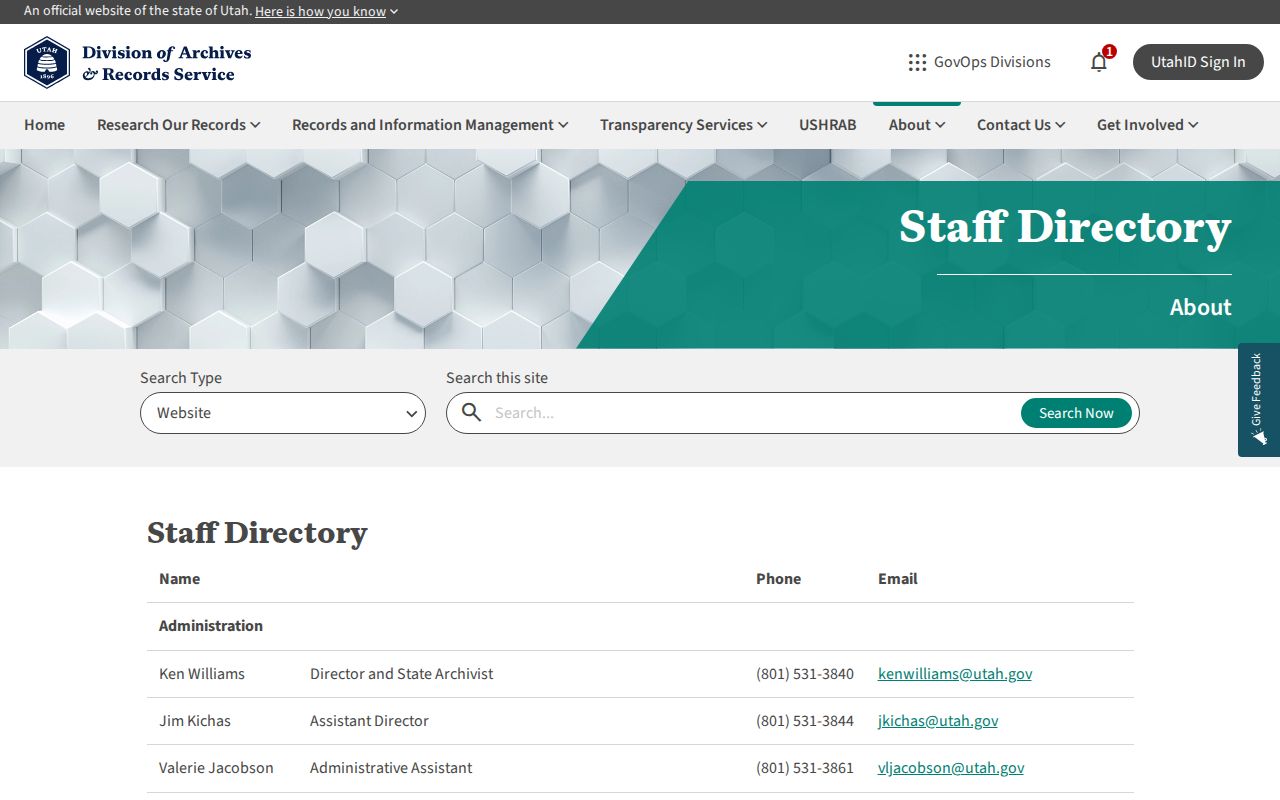
The section labels and titles add far more meaning than a name and phone number alone.
When no entry appears, check name variants and the agency's own pages. Then call its main number. A reasonably specific records request can be a last resort for an existing staff roster, but it must go to the entity that retains the record. The Utah public-records resource explains that access path without turning a directory question into a general records-law search.
Note: A missing exact-name result does not rule out a Utah agency role; spelling, local custody, and static staff pages may differ.
Utah Professional Directory Search
The DOPL License Lookup and Verification is the broadest statewide professional directory in the research. It covers more than 60 profession families. Searchers can use a name plus profession or a license number. The name tool supports a beginning-with pattern, such as a full name, initial and surname, or surname alone. It also supports a contains wildcard. Profession and license-subtype choices narrow a common name to the relevant credential.
| DOPL mode | Field | Format | What it finds |
|---|---|---|---|
| Name and Profession | Name Search | Beginning with or containing | Matching people or licensed entities |
| Name and Profession | Profession selector | Profession and license subtype | Credentials in the selected branch |
| License Number | Core number | Core digits alone | All licenses tied to that core |
| License Number | 4-Digit number | Optional suffix | One specific license |
The live DOPL screen displays both search modes and the credential hierarchy.
See the official Utah professional-directory interface captured here.
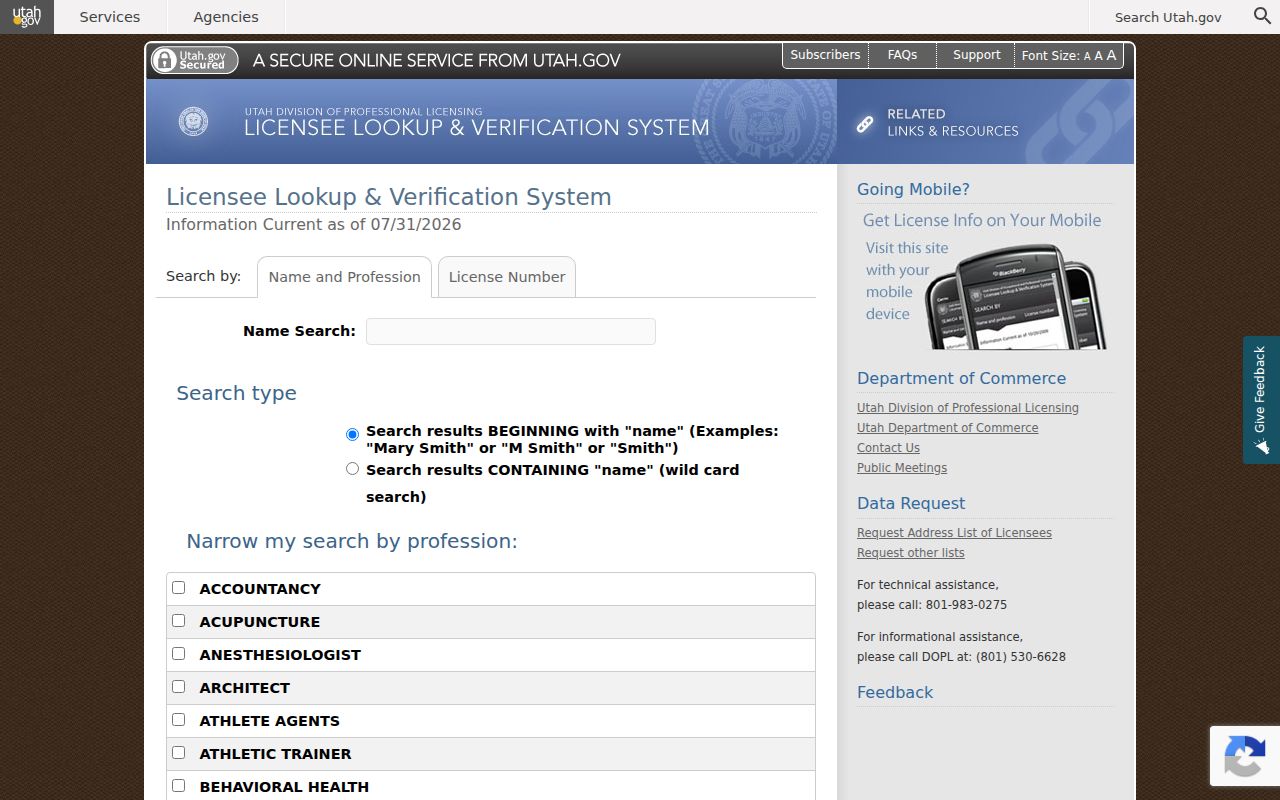
The separate modes prevent a license identifier from being confused with a person's name query.
Results may show name, city, state, ZIP or country, profession, license type, number, status, original issue date, expiration, and an agency or discipline link. Read every related credential. DOPL warns that an expired lower credential may coexist with a current higher one, and the free lookup may not show a complete history. A paid official verification is available for $5 when a stronger artifact is needed.
Utah Business People Directories
The Utah Division of Corporations search menu treats filed business roles as a directory. Business Entity Search starts with an organization. Registered Principal Search reverses the path, using a person's name to locate associated businesses. Trademark search covers registered marks, while UCC and CFS search accepts a debtor name or filing number. These entries can connect principals, officers, partners, or registered agents to the filing that names them.
Role words matter. A registered agent receives legal papers and is not automatically the owner. A principal listing reflects the filed relationship and may not prove a current home address. The business-data lists contain business names and addresses plus registered officers, principals, partners, and agents, but they expressly omit phone and email. A filing receipt date also differs from the date someone began or ended a real-world role.
Local permits and licenses sit outside this statewide directory. The incorporated city or county that issued them is the keeper. If the Utah business portal points to an entity but not the person sought, call the listed agency or search the correct municipal licensing office. Historical incorporation series may have moved to the Utah State Archives.
Note: Search each Utah filing role separately because principal, officer, partner, agent, debtor, and owner do not mean the same thing.
Utah Property-Owner Directories
Land records work like people directories, but Utah divides them among 29 counties. The Utah State Parcels map can identify the county, parcel ID, situs address, and local recorder contact. It is informational and county-fed. Its basic owner-type field is a general ownership class, not a dependable personal owner name. The named trail resumes in the county assessor roll, where owner and tax-mailing data may be available.
County recorder indexes then connect grantors and grantees to deeds, trust deeds, releases, liens, plats, and other filed instruments. A grantor transfers an interest; a grantee receives one. At the assessor or recorder counter, keep the parcel ID, legal description, owner name, document number, and book/page reference together. Older volumes may be on microfilm or held by Archives. Phone the correct office through the official county-recorder directory when the local portal is gated or incomplete.
Tax mailing and situs serve different purposes. Situs means the physical parcel location. Mailing is where the tax bill goes, which could be a trust, manager, or stale destination. Neither proves who now lives there. Pair a county roll with dated city directories, census records, deeds, or local permit files when the lawful goal is family history, heir research, or identifying a seller's recorded role.
- Parcel ID
- The county identifier joining map, tax, and land records.
- Legal description
- The lot, block, subdivision, survey, or boundary language controlling land identity.
- Situs address
- The physical location of the parcel, which may be blank on vacant land.
- Grantor and grantee
- The parties transferring and receiving an interest in a recorded instrument.
Explore Historical Utah Directories
The digitized Utah City Directories collection begins with a verified 1867 G. Owens Salt Lake directory that also carries business material for Provo, Springville, and Ogden. Other verified examples include Crofutt for 1885–86, Polk Salt Lake for 1894–95, a 1907 Blue Book, 1908 and 1912 volumes, 1929 editions, and R.L. Polk examples through 1980. Those examples do not prove one unbroken run.
Alphabetical pages find residents by surname. Geographical arrangements browse a street or address and can act like reverse directories, but the collection does not label every reverse or criss-cross year. A typical volume may show a spouse, occupation, business, residence, officers, schools, churches, clubs, hospitals, or advertisements. The 1907 Blue Book was a private address and calling guide, so it should not be treated as a complete resident list.
- 1867: G. Owens links Salt Lake residents with business listings for several other Utah communities.
- 1885–1912: Crofutt, Blue Book, and Polk editions reflect different publishers, aims, and geographic reach.
- 1929: Verified editions cover Logan and Cache County, Ogden, and Salt Lake.
- 1970s–1980: Suburban volumes and later verified Polk examples track rapid Wasatch Front change.
Check neighboring editions to spot an arrival or departure. Then compare the address with Sanborn maps, deeds, a census, newspaper notices, or a yearbook. Publication lag, abbreviations, spelling changes, widow markers, house renumbering, and edition boundaries can all create a false gap.
Note: A verified example year proves that Utah volume exists, not that the collection has every year before or after it.
Utah Directory Borders Shifted
Historic directory geography does not match a modern city map. The 1908 Polk Salt Lake edition included Murray, Fort Douglas, Garfield, and suburbs. During the 1970s, suburban books covered Draper, Granger, Holladay, Hunter, Kearns, Magna, Midvale, Murray, Riverton, Sandy, South Jordan, Taylorsville, Union, West Jordan, and White City. A person missing from a Salt Lake volume may appear in a suburban edition even when today's address feels part of the same urban area.
Utah's territorial borders also changed. Counties were formally recreated in 1851–52, and remote areas were sometimes attached to another jurisdiction. For an 1850–1896 name, search the county or court responsible in the record year, not only the county shown on today's map. The Utah Territory Project helps coordinate sources scattered among repositories, while agency histories and series inventories reveal predecessor keepers.
This geography is more than local color. It determines which directory, recorder book, court index, newspaper, or tax series could contain a name. ZIP labels are also poor substitutes for municipal boundaries. Current city permits and staff lists belong to the incorporated city or unincorporated county authority that created them.
Utah Archives Name Directories
The Utah State Archives research guides route names into government series dating from 1850. Guides cover birth, death, marriage, cemetery, divorce, naturalization, name changes, probate, criminal, military, land, and business records. Archives staff can locate and copy a specifically named record only when the series has a usable index. When it does not, the searcher must first supply an agency, date, place, case number, book/page, or other series-level key.
The Utah Historical Society digital collections broaden that record trail with more than 275,000 digitized photographs, manuscripts, and films. Named sources include railroad payroll ledgers from 1889–1919, WPA pioneer questionnaires, Salt Lake Tribune negatives, C.R. Savage portraits, Shipler photographs, legislators, city engineers, oral histories, schools, and community collections. Such sources often reconnect relatives when an official name index fails.
Newspapers fill another gap. Utah collections cover titles from Provo, Ogden, Logan, Price, Cedar City, Lehi, and distinct English-language, African-American, Catholic, and Japanese-American communities. Search spelling variants, relatives, streets, churches, military units, firms, and legal notices. An obituary can identify kin and earlier places, but its narrative should be checked against probate, cemetery, vital, or land records.
Utah name access is still growing. Preservation grants announced in 2025 supported Carbon County work on more than 13,000 marriage licenses and applications from 1930–2020. Weber County received support for about 150,000 licenses and applications, representing more than 300,000 individual records dating to 1888. Preservation does not guarantee that each name is already searchable online, but it strengthens the future directory trail.
Visit Utah Library Directories
The Utah Historical Society Library holds far more than digitized city volumes. Its collections include books, pamphlets, manuscripts, periodicals, architectural drawings, maps, yearbooks, telephone directories, and microfilm. Exact years for telephone books and yearbooks are not published as one online run, so contact research staff before traveling. The research desk is at 7292 S State Street in Midvale, with help available at 801-245-7227 or historyresearch@utah.gov.
| Collection type | Verified coverage | Best use |
|---|---|---|
| Digitized city directories | Examples from 1867 through 1980 | Residents, addresses, firms, groups, and institutions |
| Telephone directories | Held, but exact years require catalog or staff check | Dated phone and address links |
| Yearbooks | Held, but exact years vary by school and catalog record | Students, faculty, clubs, and activities |
| Microfilm and manuscripts | Collection-specific | Local sources not indexed on the open web |
The library page shows the range of Utah directory and local-history holdings.
View the official source behind the Utah Historical Society Library image.
Its broad format list explains why a catalog search or staff call may uncover more than a single keyword box.
Local city and county libraries remain important. They may hold telephone books, local newspapers, obituaries, cemetery registers, and licensed genealogy databases that have no statewide index. Ask for the local-history room and name the community plus date range. If a volume is absent online, that is not proof that it never existed. It may be onsite, on microfilm, described under a publisher, or retained by another library.