
Which Utah Public Records Exist
Utah divides record control by the office that creates or retains a file. County recorders keep deeds, liens, releases, plats, and grantor-grantee indexes. Assessors and treasurers maintain different property and tax facts. Court clerks hold case files, while the statewide Xchange system provides many public docket entries. The Office of Vital Records and Statistics, county clerks, and district courts split vital custody by event and year. State agencies separately maintain corrections, licenses, business filings, and the regulated voter file.
| Utah record group | Official keeper | Online route | Access path |
|---|---|---|---|
| Deeds, liens, and plats | County recorder | County-specific index | Portal, counter, mail, or GRAMA |
| Property and tax rolls | County assessor and treasurer | County portal; state parcel reference | Portal, inspection, or county copy request |
| Court, probate, and divorce files | Utah court clerk | Xchange | Paid index, public terminal, or clerk request |
| Vital certificates | OVRS, county clerk, or court | Applications and historical indexes | Age threshold or eligibility controls |
| Corrections and jail records | UDC or county sheriff | State and county tools | Lookup or request to the keeper |
| Licenses and business filings | DOPL and Corporations | Official state searches | Free lookup; paid verification may apply |
Open status applies to records and fields, not always to a whole file. Adoption, juvenile, sealed, expunged, and protected court matters do not appear in the public system. Recent vital certificates have eligibility rules. Motor-vehicle personal data is limited by federal law. A custodian may redact private or protected details and release the reasonably separable public portions.
Voter data has its own rules and products. The self-lookup is not an open name browser, and protected fields remain withheld. The detailed process belongs with Utah voter registration records.
Why Utah Records Start Locally
Utah has 29 independent county recorder systems and no statewide grantor-grantee index. The same local split affects assessor rolls, treasurer accounts, marriage files, jail rosters, and many municipal records. Identify the county from the event, parcel, address, or case before choosing a portal. A postal city or ZIP may cross a government boundary, so permits and code files may belong to a city or an unincorporated county office.
The official county recorder directory supplies the right office and available map or index links. If a series has moved, the Utah State Archives city and county guide helps trace the creating agency and transferred files. The Attorney General and Archives are not universal clearinghouses. A GRAMA request must go to the entity that actually retains the record.
Note: A missing statewide result does not show that a county record is absent, private, or destroyed.
Accessing Utah Recorder Records
County recorder indexes connect a grantor, the person transferring an interest, and a grantee, the person receiving it, to a recorded instrument. Modern systems vary in their dates, image access, account rules, and copy charges. Use the county portal when available. The counter, phone number in the recorder directory, mail, and a county GRAMA request remain valid fallbacks for gated or incomplete systems.
Older land work depends on stable record identifiers. Resolve the parcel and legal description, then retain the document or entry number and book/page citation. A legal description identifies land through a subdivision, lot and block, survey, or metes-and-bounds description. Street addresses can change. The Archives land-record guide routes users to entry books, deeds, plats, tax records, microfilm, and county series when an online image stops short.
Recorder tip. A deed shows a recorded title interest, not every occupant. Confirm the role and date before connecting a name to a property.
Utah Parcel Records Need County Proof
Utah State Parcels is a useful statewide reference for county, parcel ID, situs address, boundary, recorder contact, and source-date details. Its basic owner field is a generalized owner type, not a dependable personal owner name. Completeness and currency vary because counties feed the state layer on different schedules. The map is informational and is not a survey or a certified ownership record.
Move from the state map to the county assessor for the named owner, tax mailing address, value, class, and primary-residential indicator. The treasurer answers payment and delinquency questions. Then use the recorder for the actual title instrument. Situs means the parcel's physical location; the mailing address is where the tax bill goes. Neither proves that a person now lives at the site.
- Index
- A name or number tool that points to a record; it may not include the image.
- Certified copy
- An official copy authenticated by the record keeper.
- Custodian
- The agency or office that retains and responds for the record.
- Exemption
- A legal basis for withholding a record or specific fields.
Searching Utah Court Records
Xchange is Utah's paid public repository for district, juvenile, and county or municipal justice court data, subject to case restrictions. MyCourtCase is free for a party who can supply an email, case number, and government ID. It is not an open person search. Many district courts also provide public Xchange terminals, while the court clerk remains the source for a complete file, archived material, or certification.
| Xchange control | Input | How it narrows results |
|---|---|---|
| Name | Text | Public party-name criterion |
| Case number | Text | Direct case route |
| County or court location | Selector | Limits jurisdiction |
| Case type | Selector | Limits the kind of matter |
| Filing and disposition dates | Date pairs | Restricts the time span |
A docket can show case number, court, case type, parties and roles, filing or disposition status, entries, and available documents. Xchange caps results at 500, so common names need county, location, type, and date limits. Adoption, civil mental-health commitment, criminal nonpublic, juvenile, sealed, expunged, and some older justice matters are omitted. Bankruptcy belongs in the federal system.
One-time access starts with a $10 credit; searches cost $0.35 and available documents cost $1. Clerk copies use a separate schedule. Certified copies cost $4 per document plus $0.50 per page. Use the court record request route after identifying the clerk and desired docket items.
Utah Vital Records Access Windows
The Utah Office of Vital Records and Statistics holds births and deaths from 1905 forward, plus marriage and divorce abstracts for 1978 through 2010. County clerks supply marriage records outside that abstract window. District courts retain divorce decrees and files. Local health departments accept many in-person orders, and OVRS also accepts current applications by mail.
Under Utah Code Title 26B, Chapter 8, births become public after 100 years, deaths after 50, and marriage or divorce records after 75. Restricted certificates require the stated family relationship, legal authority, or direct tangible interest plus accepted identification. The search fee remains due if no record is found.
Fees effective July 1, 2026 are $25 for a first birth, marriage, or divorce search/copy and $35 for a first death search/copy; added copies are $10. Online, identity, shipping, and rush options can add charges. Historical users should search Archives name, Soundex, or browse routes before paying for a modern certificate.
Note: A public historical index can reveal identity facts without making a recent certified certificate open to everyone.
Utah Corrections Records Split Three Ways
The Utah Department of Corrections Offender Search covers people incarcerated by or supervised through UDC. Search by offender number or by first and last name, with at least one letter in the required name fields. Public results can include legal status, offender number, housing location, offenses and sentence range, board hearing, parole or expiration information, sentencing court and case, and a photograph.
Unsentenced county jail detainees do not appear there. Each sheriff controls its local booking roster and records unit, so the arrest county determines the fallback. The Utah offender registry is a third, separate system with its own statutory display rules. It redacts victim details and expressly bars harassment, stalking, and threats. Police and crash reports stay with the investigating agency; Utah Highway Patrol uses an account-based request channel and asks for the date, place, and case number when known.
Utah Business Filing Searches
Utah's Division of Corporations offers different official searches for business entities, registered principals, trademarks, and UCC or Central Filing System debtor records. The registered-principal route reverses a person's name to associated business filings. A principal or registered agent is a filing role, however, and does not by itself prove ownership or a current home address.
The Corporations search choices are shown in the official interface below.
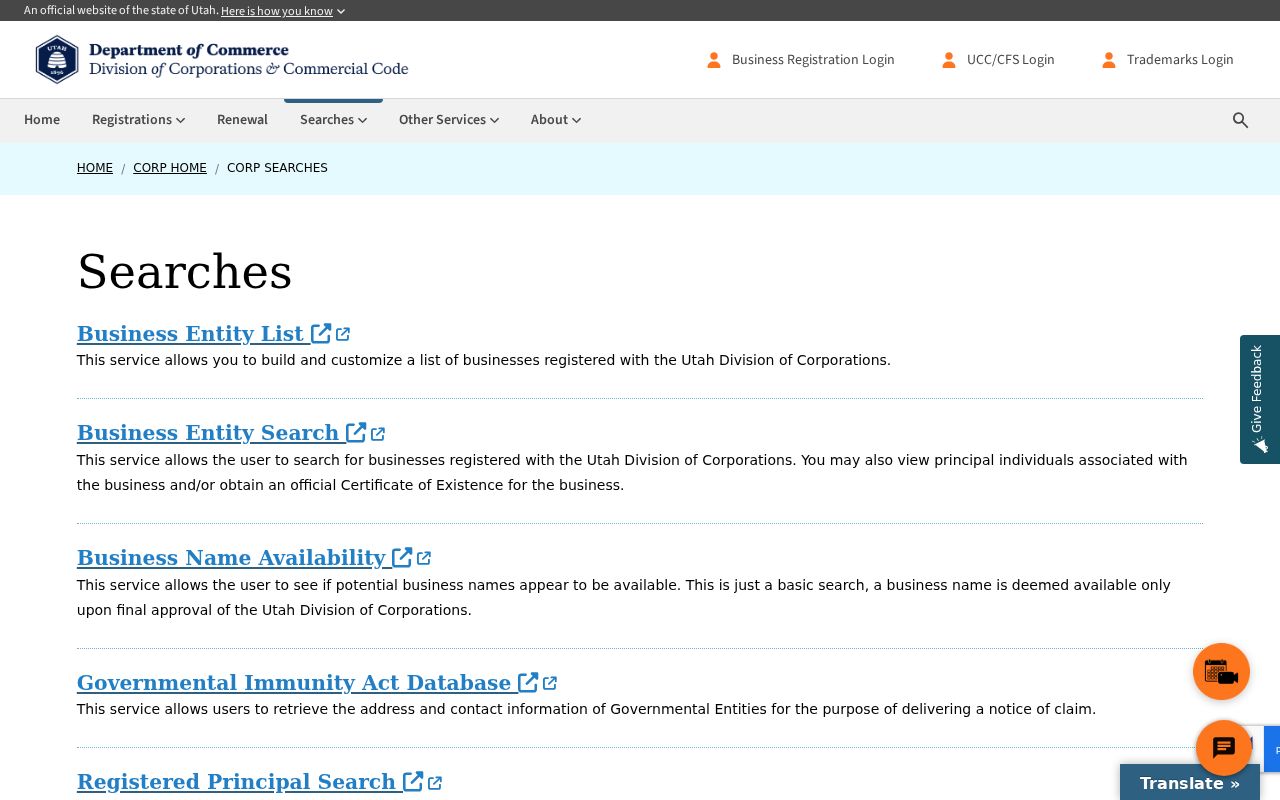
The separate search paths help users choose a business name, associated principal, trademark, or debtor filing rather than treating all roles as one result. DOPL handles regulated professional credentials through its own free lookup, while an official emailed license verification costs $5.
Utah Records Offices and Portals
State offices provide broad routes, but county and court staff still control many source files. Contact the exact keeper before sending payment or personal documents. For recorder, assessor, treasurer, clerk, sheriff, and municipal files, use the county or city office discovered through the official state directories.
Utah State Archives
Permanent state and transferred local record series, indexes, and research help.
Utah Courts
Use the statewide court directory for the courthouse and clerk tied to the case.
Submitting a Utah GRAMA Request
The Government Records Access and Management Act, or GRAMA, requires a written request to the government entity retaining the record. Under Utah Code Title 63G, Chapter 2, include your name, mailing address, daytime phone, an email if available and willing, and a reasonably specific description. Ask for an existing record, not an answer or a new compilation.
- Identify the keeper and check its public index. Use the parcel ID, case number, document number, or agency division when known.
- Describe the series, subject names, place, and a bounded date span. Ask for separable public portions if private and open fields may be mixed.
- Choose inspection or copies, a useful electronic format, and any certification. State a fee ceiling and valid waiver or expedited grounds.
- Submit through the agency's form, approved email, mail, hand delivery, or the central portal. Save the request and receipt.
- Download delivered portal files promptly, review any redactions, and preserve a denial or fee estimate for appeal.
Ordinary responses are due as soon as reasonably possible and no later than 10 business days. A qualifying expedited public-benefit request is generally due in five. Silence counts as a denial. Actual-cost fees may cover search, retrieval, formatting, and packaging at the lowest-paid qualified worker's rate, but ordinary inspection, disclosure review, and the first 15 staff minutes are generally free. Prepayment can be required above $50.
The Utah Open Records Portal offers a central submission and routing channel.
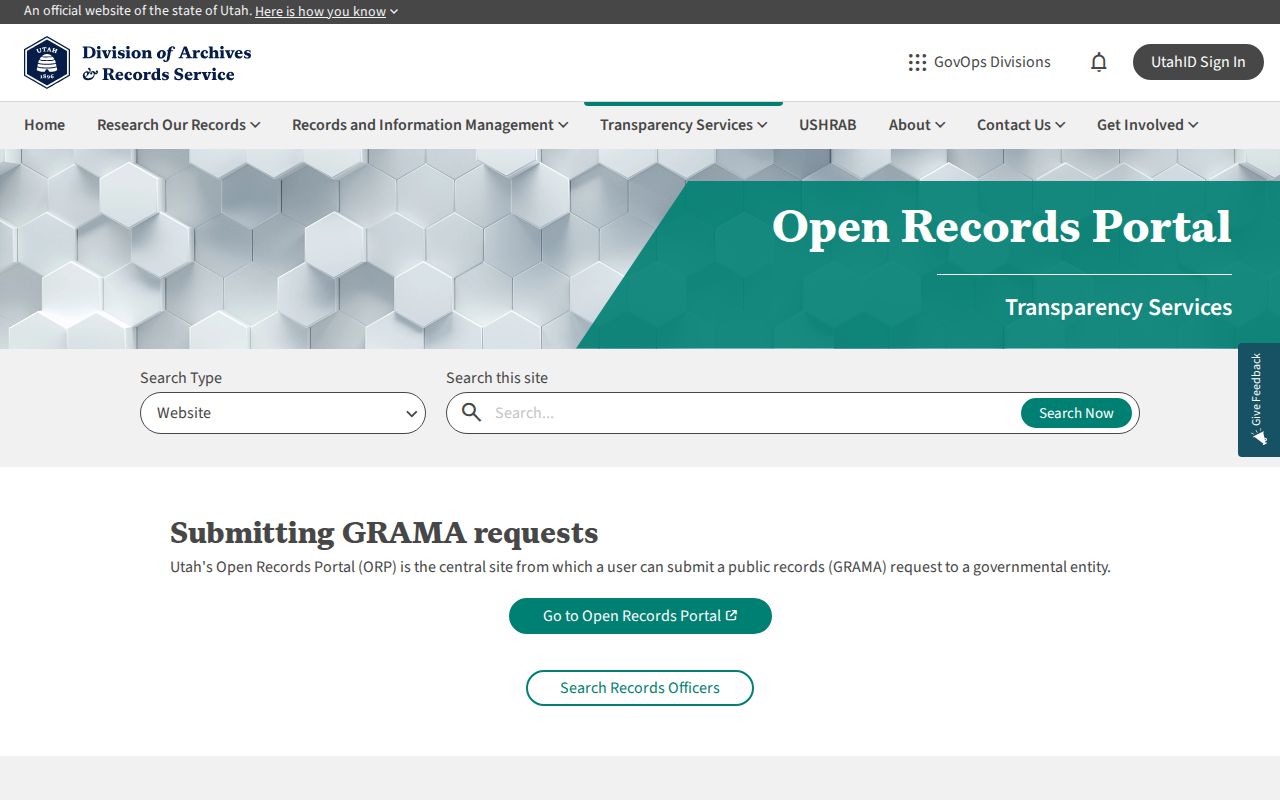
The portal does not become the custodian. Requests and responses remain there for appeal support, while furnished records are retained in the portal for only 60 days.
Lawful use. Open access supports family research, fraud checks, and civic review. Never use a record to stalk, threaten, harass, or defeat an address-protection program.
Appealing a Utah GRAMA Denial
A denial must identify the withheld record or portion, the legal basis, and the appeal route. An appeal to the agency's chief administrative officer is generally due within 30 days. The officer normally has 10 business days to decide, five for an expedited public-benefit matter, or 12 in specified business-confidentiality cases.
The next route may be the State Records Committee or district court. The Government Records Ombudsman can offer mediation. Keep the original description, submission timestamp, receipt, agency response, redaction explanation, and any invoice together. A precise appeal can challenge the classification of a field while accepting lawful redaction elsewhere.
Note: GRAMA does not override sealed-case law, vital eligibility rules, voter protections, or security classifications.
When Utah Records Stay Offline
Utah's older files reflect changing boundaries and old indexing methods. Territorial land claims preceded the first federal land office in 1869. An 1888 law then required entry books, separate instrument classes, and grantor-grantee indexes. That history explains why a legal description, party name, book/page, or entry number often succeeds where a modern address fails.
Historic court research once followed a paper name index to a case number, then to a microfilm reel and file. Archives has since digitized named indexes for several territorial and county series, including Third District territorial matters and long Salt Lake, Weber, Box Elder, and Beaver runs. Online absence can still mean that a county joined a system later, an image remains on microfilm, or the record transferred to a successor agency.
Use the Archives agency history and series inventory, then ask reference staff for the named volume, reel, or file. County-formation history matters because an early record may sit under a predecessor county or attached court rather than today's boundary.
Utah Records and Privacy Boundaries
Public status does not make every use safe or lawful. Utah's Safe at Home program gives qualifying survivors a substitute address and mail forwarding, while voter At-Risk rules protect listed vulnerable people and co-residents. These safeguards are not search obstacles to work around. They exist to keep official address trails from causing harm.
The Utah Consumer Privacy Act can provide access, deletion, portability, correction, and opt-out rights for covered commercial data. Lawfully obtained government information is excluded as publicly available data, so that law does not erase a deed, assessor entry, or court source. Correct an error with the government custodian. A separate commercial compilation requires that service's privacy process.
Use official records for a valid personal purpose, confirm identity through several non-sensitive facts, and return to the keeper before relying on a current claim. Names, addresses, dockets, licenses, and parcels all change over time.