
Utah Voter Registration Lookup
The official Find My Voter Registration Info tool is the first stop for a Utah voter checking a personal record. It is not a public name browser. The form asks for identity and residence details so the system can match the person who submits them. A successful match can confirm current status and polling information. Someone who cannot get a match should contact the county clerk, especially after a name or address change.
The lookup uses the six fields shown here. Each appears required on the live form, while the submit button is the only visible action. Date of birth is an authentication input. Its presence does not mean an exact birth date becomes part of the public voter roll.
| Lookup field | Input | Required | Purpose |
|---|---|---|---|
| First name | Text | Appears yes | Identity match |
| Last name | Text | Appears yes | Identity match |
| Date of birth | Date | Appears yes | Authentication, not public output |
| Street address | Text | Appears yes | Residence match |
| City | Text | Appears yes | Residence city |
| ZIP | Text or number | Appears yes | Residence ZIP |
The state form is visible in the official voter lookup source captured below.
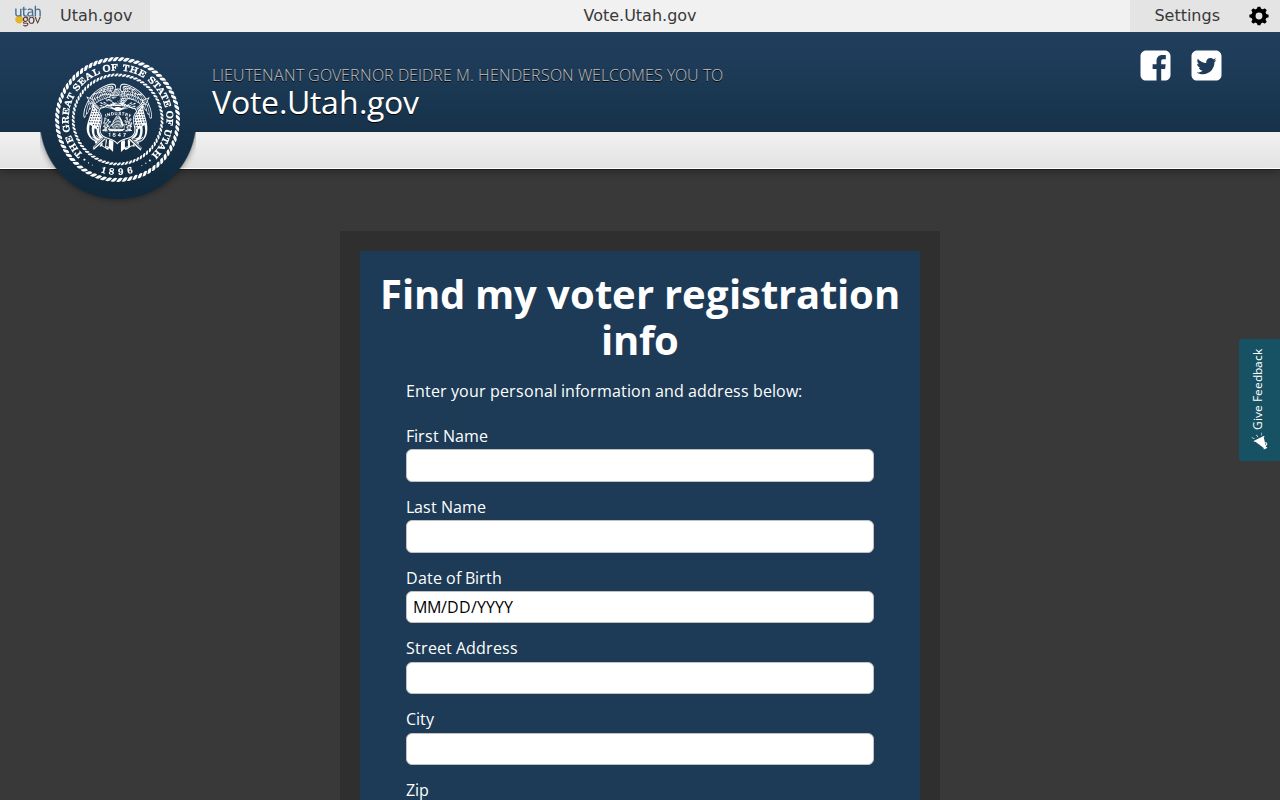
The form's identity checks explain why it cannot be used to browse unrelated Utah voters by name alone.
Note: All voters, including people whose details are withheld from public data, may use the tool to view their own record.
Utah Voter Record Contents
The public statewide file is broader than the self-lookup result. It contains a full legal name, election-system voter ID, age range, residence and mailing information, county, precinct, party or unaffiliated status, record status, last-update date, districts, and participation history. A voter ID is an election-system key. It is not a driver license number, state ID number, or Social Security number.
| Full legal name | Identifies the registered voter |
|---|---|
| Residence and mailing address | Complete addresses, which may differ; At-Risk records are excluded |
| Civic districts | Congressional, legislative, school board, county council, and city council assignments |
| Party | Affiliated party or unaffiliated status |
| Record status | Active or inactive, with a last-update date |
| Participation history | Elections in which the person participated, never ballot selections |
District fields can confirm civic geography, yet boundary changes can make an older assignment differ from a current one. Status and update date also need care. Neither proves that the person still lives at the listed address. Utah voter records are administrative snapshots, not a certified statement of present residence.
Utah Voter Privacy Boundaries
Utah draws a field-by-field line between public and government-only data. The elections office keeps exact birth dates, driver license or state ID data, Social Security information, email addresses, and phone numbers outside the ordinary public file. Beginning in January 2027, a voter may consent to share a phone number or email address with the affiliated party. Consent does not turn those fields into open public data.
The Utah voter privacy explanation shows how the state divides public, private, and At-Risk records.
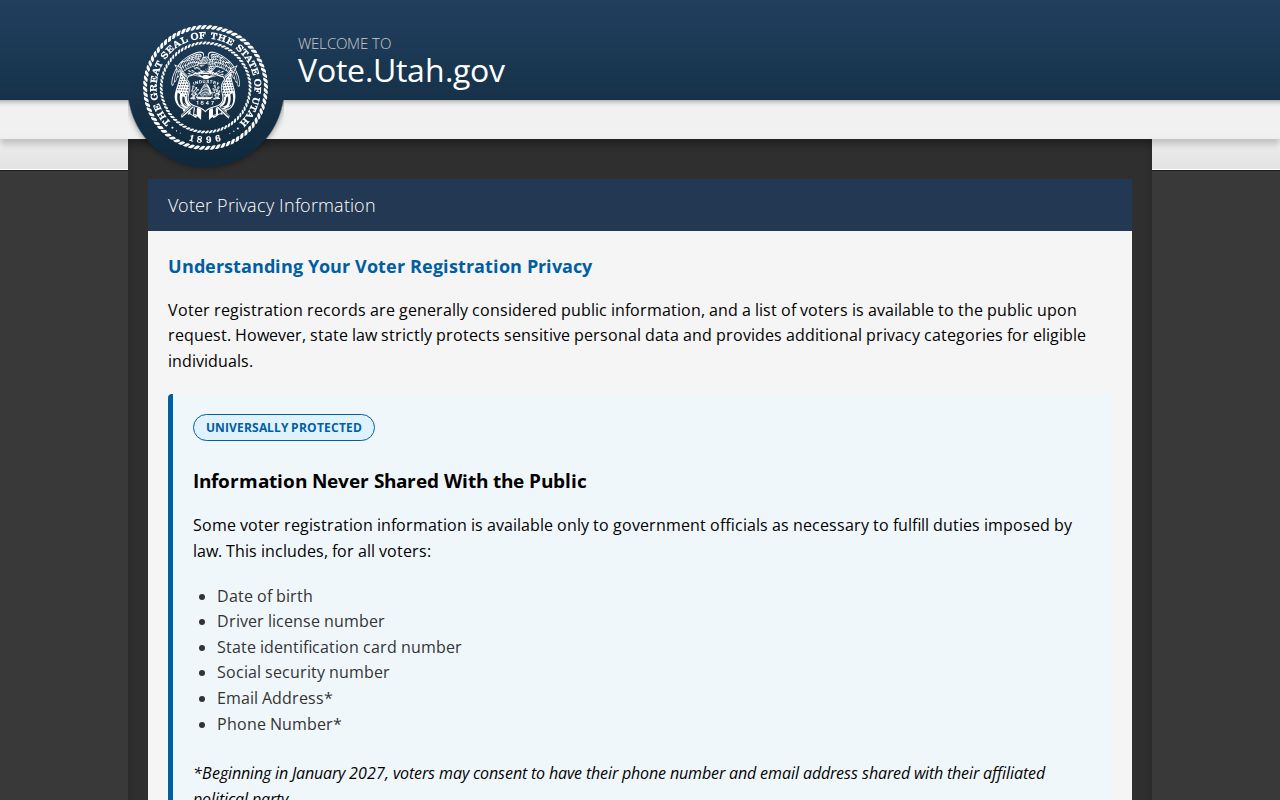
The categories matter because buying a voter file does not override a restricted field or protected designation.
Protected by Utah law. Exact birth dates, government ID data, Social Security information, contact fields, and At-Risk identifying details are withheld under Utah Code §§20A-2-602, 20A-2-104, and 63G-2-301, 302, and 202. A registration signature may be viewed where public, but it cannot be supplied as a copy or image.
Utah At-Risk Voter Protection
At-Risk status protects more than one narrow group. Eligibility can include a victim or threatened victim of domestic or dating violence, a law-enforcement officer, a person covered by a protective order, an armed-forces member, a public figure, and a co-resident of an eligible person. Identifying information is withheld except when a government entity needs it for official work. Nonidentifying totals may remain public.
A voter should work with the county clerk on the designation and use the state voter privacy process. Utah's separate Safe at Home program offers a substitute address and mail forwarding to qualifying survivors. These programs protect official data trails. They must never be treated as barriers to work around through another record source.
Note: At-Risk status remains effective when voter lists are ordered and does not vanish from the protection system at the county level.
Utah Voting History Explained
Participation history answers a limited question: whether a voter took part in a named election. It never shows a candidate, contest choice, or marked ballot. That distinction holds for the public voter roll and for election-specific reports. Ballot secrecy is not lost because an administrative system records that a ballot was issued, returned, or processed.
Does a voter record reveal a vote? No. The file can list elections participated in. “Who Has Voted” reports can add voting method and ballot-processing date for supported elections, but they do not disclose any selection. At-Risk participation may be included in totals without identifying the voter.
Use records lawfully. Public access does not permit stalking, threats, harassment, surveillance, or attempts to expose a protected address. Utah Code §76-5-106.5 reaches harmful monitoring and acquiring or sharing information by computer as part of a prohibited course of conduct.
Ordering Utah Voter Files
The Lieutenant Governor's elections office distributes the statewide public list through its voter and election data order page. The one-time file costs $1,050. It comes as a tab-delimited download of about 150 MB, and the office sends the download link by email within one business day. There is no refund, subscription, or free update with that purchase.
The ordering source and its product details appear in the official capture below.
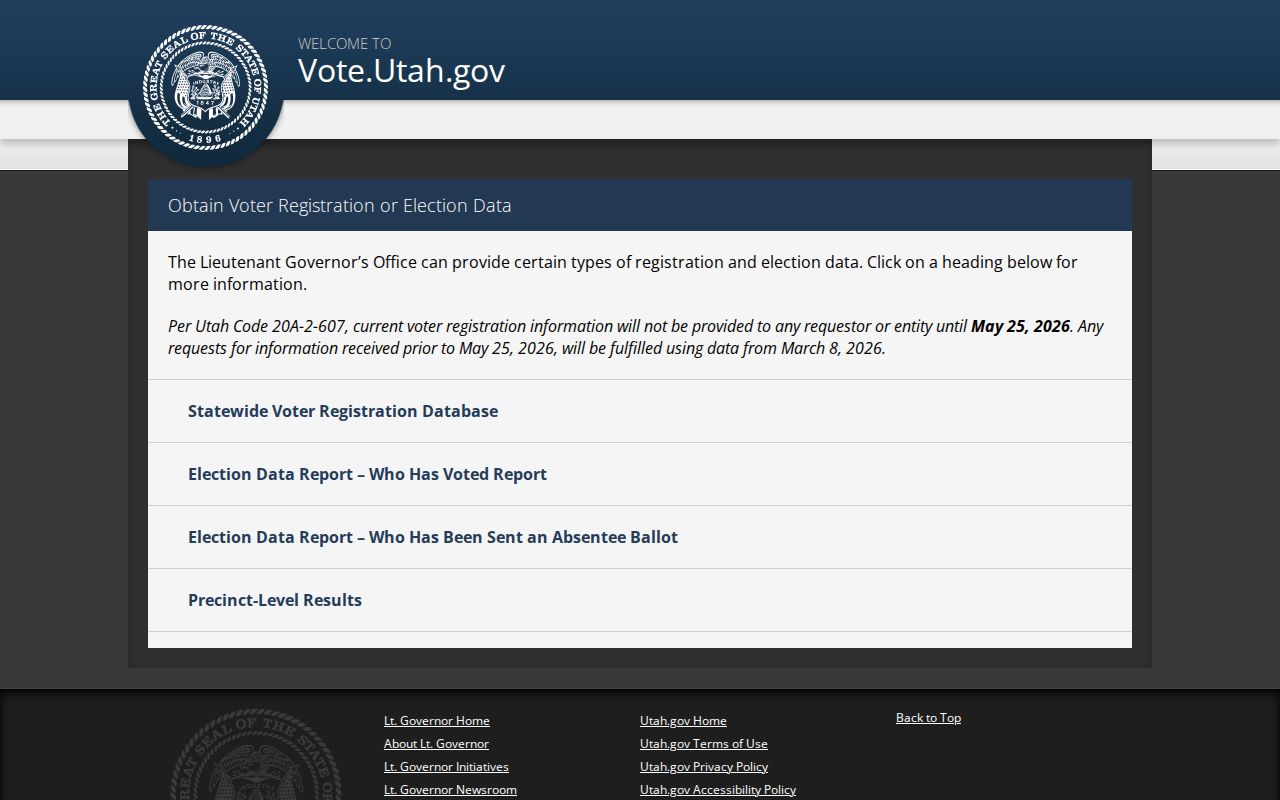
The file size is important. Ordinary spreadsheet programs may cut off rows, so the raw tab-delimited data should be opened with software that can handle the complete file without truncation.
- Choose the correct product and scope. Use the state order for all of Utah, or ask the relevant county clerk for a county or district subset.
- Complete the official web or customer-service order route and review the current terms tied to the product.
- Pay the listed charge, save the order receipt, and download the tab-delimited file from the emailed link.
- Preserve the source date and do not interpret withheld fields as missing data about an individual.
This specialized voter-file procedure sits apart from the broader Utah public records request system. A general GRAMA request does not defeat voter privacy classifications or At-Risk protections.
Utah Election Reports and Subsets
Not every research need calls for the full statewide roll. County and district subsets come from the county clerk rather than the Lieutenant Governor. The state also sells “Who Has Voted” and “Who Has Been Sent an Absentee Ballot” reports for $35 per election. Those products apply to even-year regular primary and general elections and arrive as tab-delimited daily files.
| Utah data product | Keeper | Cost | Delivery or scope |
|---|---|---|---|
| Statewide public voter file | Lieutenant Governor | $1,050 | One-time tab-delimited download |
| County or district subset | County clerk | Ask the clerk | Local geographic scope |
| Who Has Voted | Lieutenant Governor | $35 per election | Daily from 21 days before Election Day through the day before |
| Absentee ballot report | Lieutenant Governor | $35 per election | Issuance and processing, not ballot choices |
| Recent precinct results | Elections office | No fee | Published result data |
These reports answer different questions. Select the smallest product that fits the civic or historical purpose. The county clerk is also the in-person and phone fallback for a paper voter registration record, local privacy help, and questions about an individual status.
Utah Voter Roll Status
Active and inactive are maintenance labels. An inactive record does not mean that a person missed one election or can no longer resolve the record. Utah uses a notice process tied to no voting in two regular general elections and no response to the clerk's notice. The county clerk can correct or explain an individual entry.
Utah's monthly NVRA dashboard reports confirmation mail, returned updates, undeliverable mail or ballots, moves, death, voter-requested changes, inactivity, and removals. Detailed removal-reason data starts in November 2025, with earlier material planned. The reports are kept for two years. A careful reader treats the maintenance reason and report date as context, not proof of a person's location or eligibility.
Note: Voter status changes as registrations and maintenance actions are processed, so record the report date and confirm a current question with the county clerk.
Utah Registration Counts and Freeze
The current state voter statistics reported 1,778,184 active and 310,424 inactive records on July 20, 2026, for a total of 2,088,612. Historical spreadsheets cover 2014 through 2026. Those totals are useful for trends and statewide context, but they should not be used to infer anything about a named voter.
A dated 2026 rule also affected file currency. Utah Code §20A-2-607 froze the release of current data until May 25, 2026. During that pause, requests were filled with a March 8 snapshot. The freeze was temporary, not a standing rule. Anyone comparing files from that period should keep the snapshot date with the data and check the live order page for current terms.
Utah Historical Voter Records
Utah voter records are permanently retained, but no verified statewide year range covers every historical poll book or registration register. The practical route begins with the county and election year. Ask the county clerk about locally retained paper records, then search the Utah State Archives city and county records guide for transferred series.
Older records reflect changing county lines and local custody. Utah Territory ran from 1850 to 1896, and county boundaries shifted as the region changed. A historic entry may sit with the county or predecessor jurisdiction that created it, not the county shown on a modern map. Archives series descriptions, clerk-held registers, and poll books should be checked before concluding that an online absence means no record exists.
Online access, office contact, written order, and historical research each serve a different need. The six-field lookup verifies the current voter's own status. Public files and reports provide lawful civic data. County clerks explain local records and subsets. Archives holdings carry the trail back when modern portals stop.